People still need their pastor
Messages need preparation. Families need care. Leaders need development. Crises do not wait because a reel still needs captions.
Our mission is simple: we want to help churches focus on what they do best—ministering to their congregations—while we take care of their digital presence.
Most pastors did not enter ministry to become copywriters, media buyers, video editors, web managers, and content strategists. Yet those responsibilities keep arriving because the people your church is called to reach are already online.
Messages need preparation. Families need care. Leaders need development. Crises do not wait because a reel still needs captions.
People are searching, watching, comparing, and deciding whether to visit long before they walk into a Sunday service.
Social media, video, design, websites, SEO, paid ads, Google, email, analytics, and visitor follow-up each require real expertise.
When work is split among staff, volunteers, freelancers, and vendors, someone still has to keep every message and deadline connected.
Church marketing is valuable when it removes friction between a person and a meaningful next step. It can help someone hear a message, understand what your church believes, find answers before visiting, and feel expected when they arrive.
That is why we refuse to think about reach, clicks, videos, websites, and planned visits as empty numbers. Every number represents a person with a story.
Behind every reach number is a person. Behind every planned visit is a story. Behind every story is a reason to do this work with excellence.
A sermon clip, graphic, search result, video, or ad reaches someone who may never have heard of your ministry.
Consistent content and a clear website help them understand your voice, values, leadership, and community.
A visitor campaign, event page, or call to action gives them a simple way to take the next step.
Thoughtful follow-up answers questions, reduces anxiety, and helps a future guest know someone is ready to welcome them.
Tools, platforms, and algorithms will continue to change. These commitments keep our church marketing strategy grounded in the ministry and people it is meant to serve.
Marketing is a support system for the calling of the church. It should never become more important than the people being served.
Theology, language, culture, demographics, leadership, and ministry goals must shape the work before a caption or campaign is created.
The goal is not to make your church sound like an agency. The goal is to help your church sound unmistakably like itself.
Content, video, design, websites, SEO, and advertising should reinforce one another instead of operating as disconnected tasks.
Church social media should encourage, educate, and serve people—not simply announce another event every time the church posts.
Reporting matters, but the purpose is better stewardship and clearer decisions—not chasing vanity numbers that do not serve the mission.
We do not want to hand pastors a strategy document and another list of things to do. Our departments work together to execute the plan while your marketing manager keeps the work organized and connected to your church.
A dedicated marketing manager learns your church, coordinates the team, organizes approvals, and keeps the work connected to your goals.
See how the team works → 02Sermon clips, social graphics, reels, event promotions, series branding, thumbnails, and videos created around your church's message.
Explore our portfolio → 03Targeted advertising, Plan Your Visit landing pages, campaign creative, automated follow-up, optimization, and reporting.
See visitor campaigns → 04Website creation and management, landing pages, local SEO, Google Business Profile support, and Google Ad Grant management.
Explore Google support →These published Plan Your Visit results show what can happen when the message, creative, targeting, landing page, and follow-up work together.
The campaign produced planned visits at $7.67 each after the learning phase. The church eventually asked for the campaign to pause after reaching full capacity.
Read the campaign details →The Los Angeles church reported continued new visitors nearly every weekend after investing in the Plan Your Visit campaign system.
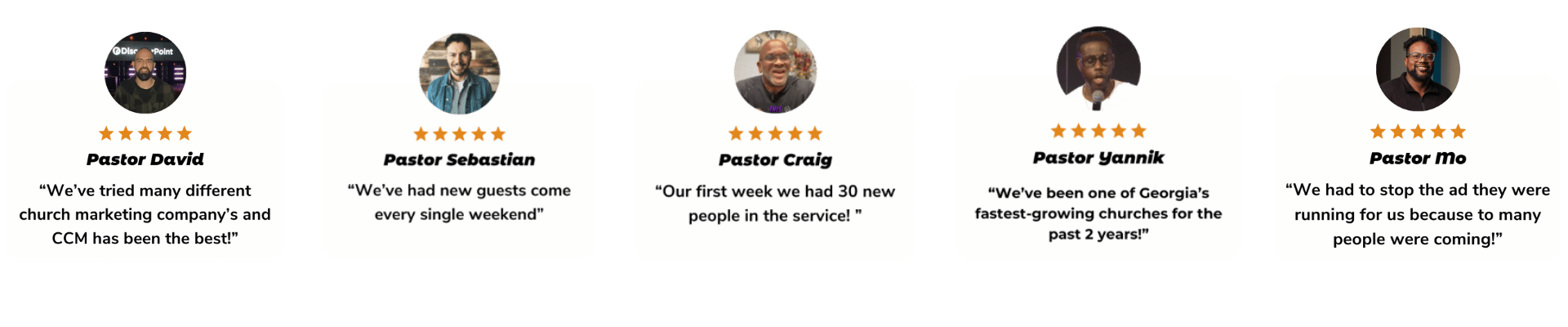
Explore the case study →Reported 70% growth and said CCM stood apart after his church had worked with several other agencies.
Reported that 30 new people attended the service during the church's first week of results.
Reported that the church was continuing to welcome new guests nearly every weekend.
Results vary by church, location, audience, creative, advertising budget, offer, follow-up, and execution. These examples do not guarantee identical outcomes.
A strong agency relationship should not create another department for the pastor to manage. It should provide clarity, ownership, visibility, and dependable people who know what they are responsible for.
We want you to know who to contact, what is being created, why it is being created, what needs your approval, and what the results are teaching us.
Clear answers about the role marketing can play, how CCM works with pastors, and what makes a ministry-focused partnership different.
Ask us a specific question →Creative Church Marketing exists to help pastors and ministry teams focus on serving people while a specialized church marketing team manages the demands of digital communication. We become an extension of the church's staff across strategy, content, advertising, video, websites, search, and visitor pathways.
Modern church marketing involves several specialized disciplines, including social media strategy, copywriting, graphic design, video editing, websites, SEO, paid advertising, Google management, analytics, and follow-up. An agency can provide those skills without requiring the church to hire and manage a separate full-time employee for every specialty.
CCM is structured specifically around churches and ministry communication. Our team learns the church's theology, language, culture, audience, city, goals, and ministry rhythm before building the strategy. The work is coordinated through one team rather than several disconnected vendors. You can see the complete structure on our How It Works page.
Your church is assigned a marketing manager responsible for learning the ministry and coordinating the work. Onboarding documents your theology, terminology, demographic, visual style, leadership preferences, goals, and communication rhythm. A shared content calendar also gives your team the ability to review and provide feedback before content is published.
No. Marketing cannot replace preaching, discipleship, pastoral care, community, hospitality, or meaningful relationships. Its role is to help more people discover the church, understand what it offers, and receive a clear invitation to take a next step. The church still carries the responsibility of ministering to the people who respond.
Depending on the selected service plan, CCM can support social media management, captions, graphics, sermon clips, promotional videos, YouTube, website creation and updates, local SEO, Google Business Profile work, Google Ad Grant management, Meta and YouTube advertising, Plan Your Visit campaigns, follow-up systems, and reporting. Current options are available on the Pricing page.
Measurement depends on the goal. Reporting may include content reach, engagement, follower growth, video performance, website activity, search visibility, ad performance, inquiries, conversions, and planned visits. The purpose is to learn what is working, improve what is not, and connect activity to meaningful next steps.
Bring us the vision, the burden, the imperfect systems, and the people you are trying to reach. We will listen, look at what is happening now, and help you identify a practical next step.
“We’ve Grown by 70%…we’ve worked with over 4 different agencies and none are like you.” – Pastor Elliot
“Our first week we had 30 new people in the service! ” – Pastor Greg
“They have been absolutely amazing! ” – Pastor Lawson
“We’ve had new guests come every single weekend” – Pastor Sebastian